
‘I am not so comfortable with therapy. I know I need it, but I am not so sure about it because what if the therapist does not understand my queer identity? What if the therapeutic process is not meant for me?’
A perfectly valid question. And especially from someone who identifies as queer. People from the LGBTQIA+ or queer community may have this fear of being misunderstood or judged by society. This fear of judgment is often experienced in the therapeutic space, too, where one is vulnerable and hopes to be accepted and understood without any prejudice.
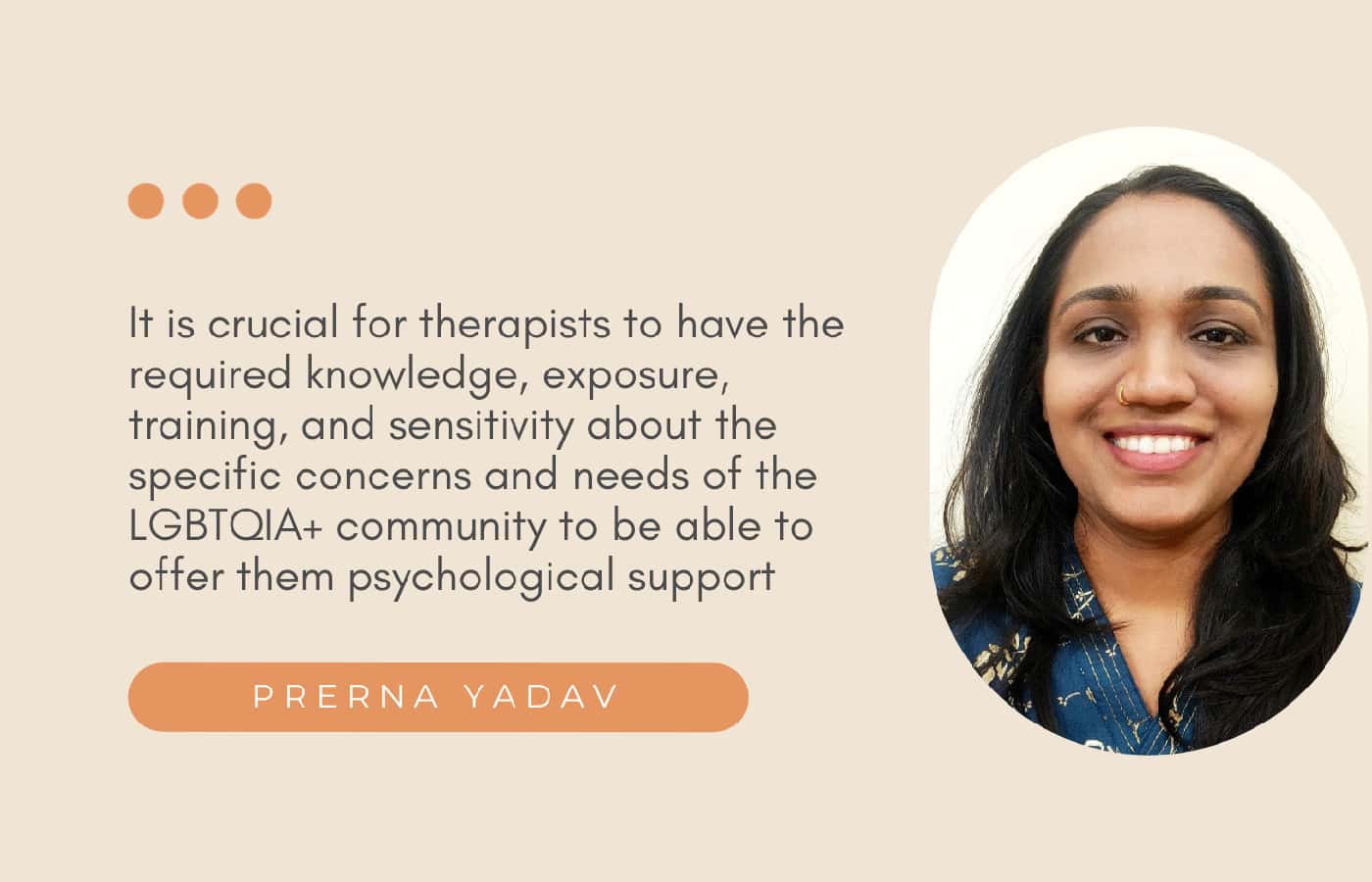
In the therapeutic space, it is crucial for therapists to have the required knowledge, exposure, training, and sensitivity about the specific concerns and needs of the LGBTQIA+ community to be able to offer them psychological support. Therapists who do possess the understanding and training to offer support to the queer community are called mental health professionals with a queer-affirmative lens.

We spoke to Prerna Yadav, a queer-affirmative psychologist, to shed light on queer-affirmative therapy.
Why is it essential for psychologists with queer clients to possess a queer-affirmative lens?
The queer affirmative lens aims at making therapy more accessible and inclusive for individuals from the queer community and other marginalized communities. Affirmative practice promotes sensitivity to the unique stressors of the queer community, by recognising the intersections of power and privilege across different social identities, namely, gender, sexuality, social class, caste, religion, ethnicity or disability.
What distinguishes queer-affirmative practice from traditional therapy?
Traditional therapy often employs a diagnostic and pathological lens of mental health. In contrast, queer-affirmative therapy uses a non-pathologizing lens of mental health by identifying systemic inequalities contributing to the unique stressors of marginalized communities and their impact on mental health.
Given this, are there unique challenges that the queer community faces?
The queer community faces unique challenges due to cis-heteronormativity, which oppresses individuals who are not cis – heterosexual.
Some unique stressors of the queer community include difficulties with self-acceptance, the pressure and fear of coming out, invisibility/erasure, discrimination, isolation, internalized homonegativity/transphobia/queerphobia, gender dysphoria, misgendering, etc.
And there’s another thing as well that’s part of queer-affirmative therapy, right? Gender-affirming therapy?
Gender Affirming Therapy is spoken of frequently while addressing the mental health needs of Transgender & Non-Confirming Individuals (TGNC). As defined by American Psychiatric Association, ‘Gender Affirming Therapy is a therapeutic stance that focuses on affirming a person’s gender identity and does not try to “repair” it’.
Some of the goals of Gender Affirming Therapy include addressing the mental health challenges of TGNC people namely, gender dysphoria, internalized shame, trauma due to prolonged violence, discrimination, bullying, misgendering, social erasure, invisibility, and social stigma. It also focuses on helping TGNC individuals identify a support system within the queer community and connecting them with other services like legal aid or medical aid.
Mariwala Health Institute has brought out a QACP ( queer-affirmative Counseling Practice Resource) book to support mental health professionals in developing a queer-affirmative lens. Have you used it? Would love to know your thoughts.
Yes, I have read the QACP manual published by Mariwala Health Initiative and often use it as a reference in my therapy work. It’s a comprehensive resource, which apart from educating and sensitizing professionals about the unique challenges of the queer community, seeks to deconstruct their own beliefs about gender, sexuality, systemic privilege, oppression and intersectionality through reflective activities, case examples, and discussions. The content of the manual is user-friendly and easy to understand, making it more accessible as a resource.

What is the difference between a queer-affirmative therapist and a therapist just supporting queer values?
A therapist who’s a supporter of the queer community is likely to be accepting toward queer individuals and may be able to support them while they experience distress. Beyond the therapy space, they may also try to interact with people from the community to understand their experiences.
On the other hand, a queer-affirmative therapist undertakes self-reflection of their own cis-het beliefs, values, biases, and educates themselves about the unique life stressors of queer individuals and how intersections of different social identities lead to experiences of privilege or marginalization. They help clients cope with trauma, abuse, violence, and feelings of internalized homophobia/queerphobia/transphobia and publicly advocate for queer rights.
———————————————–
The queer-affirmative lens is not just a buzzword. It is a prerequisite for therapists engaging with queer clients. And also, while searching for a therapist, it’s important to enquire if they come with a queer-affirmative background.
By promoting a more non-pathologizing lens of mental health, the queer-affirmative Lens is a major shift in the therapeutic approach and is a step to create an understanding that mental health issues are also a result of systemic inequalities, power imbalances, and challenges.
You can also check out therapist Aanya Wadhwani on exploring therapy from a queer lens on The MyndStories Podcast.