

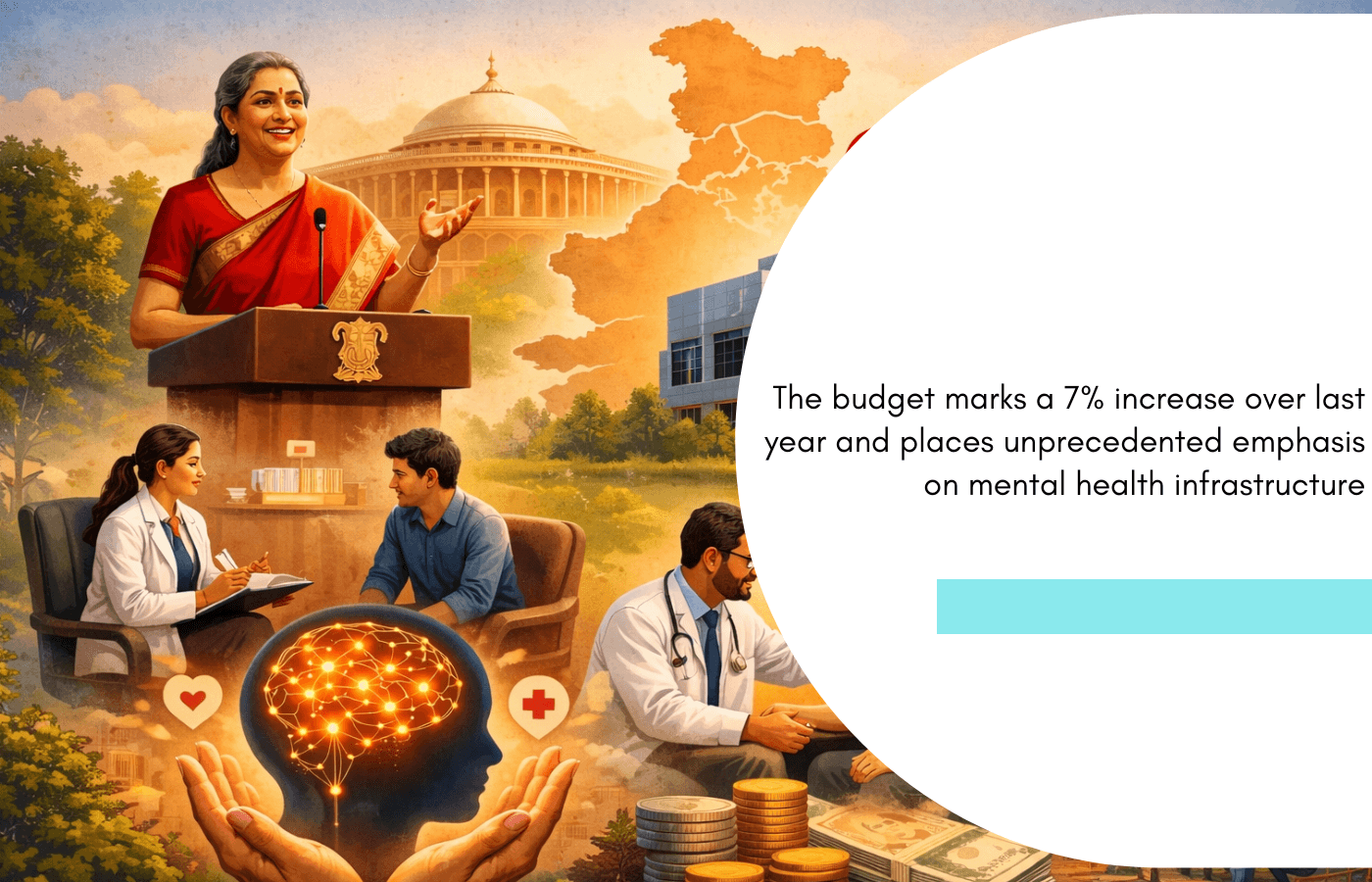
In a landmark move that signals mental health as a national priority, Finance Minister Nirmala Sitharaman announced the establishment of NIMHANS 2.0 in North India and a substantial increase in health-sector allocation to ₹1,16,870.58 crore in the Union Budget 2026-27, presented in Parliament on Saturday.
The budget marks a 7% increase over last year and places unprecedented emphasis on mental health infrastructure, addressing a crisis that affects nearly 197 million Indians while leaving 70-92% without adequate treatment.
The mental health infrastructure expansion
The centerpiece of the budget's mental health provisions is the creation of NIMHANS 2.0, modeled after Bengaluru's National Institute of Mental Health and Neuro Sciences, India's premier mental health institution.
"Reaffirming our commitment to mental health and trauma care, there are no national institutes for mental health care in North India. We will therefore set up a NIMHANS 2.0 and also upgrade national mental health institutes in Ranchi and Tezpur as regional apex institutions," Sitharaman stated during her ninth consecutive budget presentation.
The announcement addresses a critical geographical gap. Currently, NIMHANS in Bengaluru serves as the nation's sole premier mental health research and treatment institution, leaving vast regions of north, east, and northeast India without comparable facilities.
The Central Institute of Psychiatry in Ranchi and the mental health institute in Tezpur will be upgraded to function as national hubs for treatment, professional training, and policy-driven research, helping decentralize services currently concentrated in urban centers.
The scale of India's mental health crisis
The budget's focus on mental health comes against a sobering backdrop of statistics that reveal the magnitude of the challenge.
According to the National Mental Health Survey conducted by NIMHANS in 2015-16, approximately 13.7% of India's population suffers from some form of mental illness, with 10.6% requiring immediate intervention.

In absolute numbers, this translates to 197.3 million people living with mental disorders, including 45.7 million with depressive disorders and 44.9 million with anxiety disorders, according to the Global Burden of Disease Study 2017.
The treatment gap is staggering. Between 70 and 92% of people with mental disorders receive no formal treatment, according to the National Mental Health Survey. Urban metro regions show higher prevalence at 13.5% compared to rural areas at 6.9%.
The Economic Survey 2024-25, presented just days before the budget, highlighted mental health as a critical issue, particularly among young people. The survey cited NCERT data showing 11% of students feeling anxious, 14% experiencing extreme emotions, and 43% experiencing mood swings, with the COVID-19 pandemic exacerbating these trends.
Among young adults pursuing higher education in tier-1 cities, 69.9% exhibited moderate to high levels of anxiety, 59.9% showed depression, and 70.3% experienced distress, according to a 2024 cross-sectional study.
Recent studies have found that 74 %of Indians suffer from stress, while 88 % suffer from some form of anxiety disorder, with symptoms including increased heart rates, hyperventilation, chronic fatigue, and difficulties with concentration.
The human resource crisis
India faces a severe shortage of mental health professionals. The country has approximately 0.75 psychiatrists per 100,000 people, far below the World Health Organization's recommended minimum of 3 per 100,000.
As of 2018, India had only 3,827 registered psychiatrists against the 13,500 required, according to statements from the then Minister of State for Health and Family Welfare.
The shortage extends beyond psychiatrists. India lacks adequate numbers of clinical psychologists, psychiatric social workers, and psychiatrically trained nurses, with these professionals even fewer in number than psychiatrists.
While postgraduate psychiatry training seats have increased from 450 per year a decade ago to approximately 1,500 currently, a significant number of trained professionals leave the country for better prospects abroad.
Most mental health specialists work in cities, leaving rural districts with little or no access to specialized care. Many medical graduates lack confidence in diagnosing and treating common mental disorders, even after short training, as undergraduate exposure to psychiatry remains limited.
Budget allocations and health priorities
The Ministry of Health and Family Welfare received ₹1,06,530.42 crore, representing an increase of nearly 10% over the revised estimates for 2025-26.
Union Health Minister J.P. Nadda highlighted that this reflects a cumulative 176% increase in the health budget over the past 12 years compared to 2014-15.
The Department of Health and Family Welfare's allocation rose to ₹1,01,709.22 crore from ₹95,957.87 crore, supporting ongoing schemes including the National Health Mission, Ayushman Bharat, hospital infrastructure, and emergency care.
The Department of Health Research, which houses the Indian Council of Medical Research, saw its allocation jump to ₹4,821.21 crore from ₹3,900.69 crore, a 26.98 % increase underscoring emphasis on medical research and clinical trials.
"This budget places a special focus on mental health and combating mental illness, which is a welcome step," Nadda stated. "The upgradation of the Central Institute of Psychiatry in Ranchi and Tezpur, and the announcement of the establishment of a new NIMHANS in North India are commendable."
Beyond infrastructure: comprehensive health measures
The budget's health provisions extend beyond mental health to address several critical areas:
Emergency and trauma care: The government plans to establish emergency and trauma care centers in every district hospital across the country, providing round-the-clock, affordable emergency services. This builds on systems and capacities developed during the COVID-19 pandemic.
Cancer and rare disease relief: The budget announced a waiver of basic customs duty on 17 cancer drugs and medicines. Additionally, seven rare diseases have been brought under the duty exemption for personal imports of drugs, medicines, and specialized nutritional products.
Biopharma manufacturing: The budget outlined the Biopharma Shakti initiative with an outlay of ₹10,000 crore over five years, creating a network of over 1,000 accredited clinical trial sites to facilitate domestic production of biologics and biosimilars.
Digital health: The Ayushman Bharat Digital Mission received ₹350 crore, an increase of nearly 8 %, to strengthen digital health records, telemedicine, and hospital information systems.
Medical hubs: The government proposed supporting states in establishing five regional medical hubs in partnership with the private sector, serving as integrated healthcare complexes combining medical, educational, and research facilities.
Ayurveda expansion: Three new All India Institutes of Ayurveda will be established to strengthen research in traditional medicine and meet growing global demand.
Existing mental health initiatives
The budget builds on several existing mental health programs that have shown promise but face implementation challenges:
The National Tele Mental Health Programme, launched in October 2022, operates 53 Tele MANAS cells across 36 states and union territories. As of October 2024, more than 14.5 lakh calls had been handled on the helpline.
The World Health Organization has praised Tele MANAS as an effective and scalable mental health solution, making mental healthcare more inclusive and affordable.
The District Mental Health Programme, launched in 1996, aimed at integrating mental health services with general healthcare but has remained largely psychiatrist-oriented, with the desired transfer of care to general medical officers not fully achieved.
The Mental Healthcare Act of 2017 and the National Mental Health Policy of 2014 outline strategies for improving mental health and safeguarding rights, but implementation has faced challenges in resource allocation and clarity on timelines.
The economic and social burden
Mental health disorders contribute significantly to India's disease burden. The contribution of mental disorders to total disability-adjusted life-years (DALY) increased from 2.5% in 1990 to 4.7% in 2017. Depressive disorders contribute most to the mental disorder burden at 33.8%, followed by anxiety disorders at 19 %, according to the Global Burden of Disease Study.
Poor mental health results in reduced performance, absenteeism, and higher staff turnover. Globally, depression and anxiety contribute to the loss of approximately 12 billion workdays annually.
The National Mental Health Survey reported an 83% treatment gap for mental disorders, with 20% of households falling into poverty due to spending on mental health treatments.
With approximately 60% of the global population in some form of employment, addressing mental health at work has become imperative, particularly as work-related stress reaches epidemic proportions in India.
A recent survey found that close to 90% of Indians felt that information overload and scattered information contributed to highest stress levels among working professionals.
Expert reactions
Medical professionals and policy experts have welcomed the budget's mental health focus while noting implementation challenges.

Dr. Naresh Trehan, chairman of Medanta, described the budget as "forward-looking," specifically praising the focus on mental health infrastructure.
"There are huge mental health problems that are because of the stresses of society, including pollution. The fact that the establishment of mental health institutes is a very positive move forward," Trehan stated.
However, he noted the overall health allocation hasn't seen dramatic increases. "We need to double the healthcare delivery system over the years, especially in rural health. While states have been offering incentives for tier-two and tier-three cities, there was no mention of this in the budget."
Minister of State Anupriya Patel highlighted the Biopharma Shakti Mission, stating it will help India become a manufacturing hub of biopharma, representing "a big step towards self-reliance."
Implementation challenges ahead
While the budget announcements represent significant policy commitment, several challenges lie ahead in implementation.
Funding clarity: Details on specific funding allocations for NIMHANS 2.0 and upgrades to Ranchi and Tezpur institutes remain unclear. Implementation timelines have not been specified.
Human resources: Building new institutions is only part of the solution. India needs to dramatically scale up training of psychiatrists, clinical psychologists, psychiatric social workers, and nurses.
Urban-rural divide: Mental health services remain predominantly concentrated in urban areas. The new institutions must develop robust outreach and community-based models to serve rural populations.
Integration challenges: Mental health services need better integration into primary healthcare. The District Mental Health Programme's limited success in achieving this integration suggests systemic barriers beyond infrastructure.
Cultural adaptation: Psychological interventions are often based on Western models focused on individualism. India requires culturally adapted approaches that account for collectivism, interdependence, family structure, and cultural beliefs.
Stigma reduction: Infrastructure alone cannot address the stigma that prevents people from seeking help. Nearly 80 % of respondents in the National Mental Health Survey had never heard of schizophrenia or bipolar disorder.
Coordination: Multiple initiatives exist—Tele MANAS, District Mental Health Programme, Health and Wellness Centers, private sector—but coordination and integration remain weak.
The path forward
The establishment of NIMHANS 2.0 represents more than infrastructure expansion. It signals governmental recognition that mental health is not merely a health issue but a development priority with economic implications.
By replicating the NIMHANS model in North India, the government aims to:
Scale specialized psychiatric care, trauma management, and neurosciences expertise to underserved regions
Expand postgraduate and specialist training for mental health professionals
Establish regional centers for policy-driven research
Improve clinical outcomes through structured environments and multidisciplinary teams
Strengthen India's capacity to respond to rising cases of depression, anxiety, addiction, and trauma
The upgrade of institutes in Ranchi and Tezpur as regional apex institutions aims to strengthen access to quality mental healthcare in eastern and northeastern India, regions that have historically been underserved.

For the budget's mental health provisions to achieve their potential, several conditions must be met:
Sustained funding: One-time announcements must translate into multi-year budgetary commitments with clear allocation pathways.
Workforce development: Dramatic expansion of training programs for all categories of mental health professionals, with incentives to practice in underserved areas.
Community integration: Institutional care must link effectively with community-based services, primary health centers, and digital platforms like Tele MANAS.
Research focus: The new institutions must prioritize research on culturally adapted interventions, epidemiology of mental disorders in India, and cost-effective service delivery models.
Public awareness: Parallel investments in mental health literacy campaigns to reduce stigma and improve help-seeking behavior.
What it means for patients
For the estimated 197 million Indians living with mental disorders, the budget offers hope of improved access to specialized care, particularly in regions that have lacked national-level institutions.
For severe mental health conditions requiring intensive, round-the-clock care—schizophrenia, bipolar disorder, acute depression—the establishment of additional national-level institutions could be transformative, particularly if they develop robust outpatient and community follow-up systems.
For common mental disorders like anxiety and depression affecting tens of millions, the real test will be whether infrastructure expansion translates into accessible, affordable care at the primary healthcare level where most people first seek help.
For families bearing the financial burden of mental health treatment—with 20% pushed into poverty—the combination of infrastructure expansion and integration into schemes like Ayushman Bharat offers potential relief, though details remain to be seen.
Conclusion
The Union Budget 2026-27's emphasis on mental health infrastructure represents a significant policy shift, moving mental health from the margins to the mainstream of health policy discourse.
The establishment of NIMHANS 2.0, upgrade of institutes in Ranchi and Tezpur, increased research funding, and emphasis on emergency and trauma care collectively signal that mental health is being treated as a development priority, not merely a specialized medical concern.
However, infrastructure is only the beginning. The true measure of success will be whether these initiatives translate into:
Reduced treatment gap from the current 70-92%
More mental health professionals choosing to practice in underserved areas
Greater integration of mental health into primary healthcare
Reduced stigma and improved help-seeking behavior
Affordable, accessible care for millions currently without any support
Better outcomes for severe mental illnesses through specialized institutional care
As Union Health Minister Nadda noted, the 176% increase in health budget over 12 years demonstrates commitment. The question now is whether institutional expansion, workforce development, policy implementation, and cultural change can keep pace with the scale of India's mental health crisis.
For the 197 million Indians living with mental disorders and the millions more at risk, the budget offers renewed hope. Whether that hope becomes reality depends on execution, sustained investment, and a fundamental reimagining of how India approaches mental health as both a medical and social priority.


