The other day someone I’ve known for a few years texted me. It had been a while since I’d heard from him. Soon we were chatting about his trip to Qatar for the World Cup. We hung up with plans for coffee. It was so simple – I was surprised. Pleased but surprised that getting in touch and making plans was just this easy.
My experience over the last three years has convinced me otherwise.
At the start of 2020, I was my most social self (not including time as a toddler). I had just completed a two-week trip with a dear friend from university. My work and social life revolved around a place where I’d been full-time for five years until recently, when I transitioned to a part-time role in the same organization.
When the first lockdown happened – delighted as I was about taking calls in my PJs and not spending two-three hours on the road every day, I missed my friends. Or what some people would call work friends.
I don’t like that term because it sounds insincere.
But my work friends were different.
We knew each other’s birthdays, what we liked to order for lunch, and how we felt about the managers and the HR. We hung out on Fridays. We’d hired tempo travelers to go to Kanatal, Rishikesh, and Jim Corbett. We had rituals like post-lunch walks and feeding the dogs who lived nearby. Yes, there were office dynamics also at play. There were ups and downs, like in every friendship. But I believed that friends were friends.
Part 1: Circumstance
Then, in 2020, we were all prised apart – connected only by technology and the habits we’d formed.
We were still chatting every day, even when I wasn’t working. Transitioning to hanging out online was, for me, the least complicated part of the ‘new normal.’
I took this dynamic for granted, interpreting the lockdown as only an interruption in the rhythms and rituals of my friendships like vacations had been in the school year.
But this was different.
We were not starting a new year any time soon. We were no longer obliged to sit in that room with the funky green cabinets for at least 40 hours a week or argue about the AC’s temperature or who needed the heater the most in winter or decide when to have lunch. As with every relationship, circumstances had been critical to the start of our friendships.
And now, not to be dramatic, but those had changed forever.
Part 2: Convenience
With the pandemic raging, we were all facing uncertainty and anxiety. There were real human questions we grappled with every day. And most of my friendships, in the absence of physical context, found themselves in a rut.
If they were to continue, we would have to go beyond mere circumstance. We had to risk the comfort of old habits and learn how to be present. We had to find out what connected us beyond the place where we worked.
This proved difficult.
A few of my circle simply dropped off the radar saying, “What’s there to talk about?” or “I’m not the texting type.” Those who were the texting type took exception to paragraphs or long voice notes. In other words, to real talk.
Now I’m a badge-holding introvert, but I quickly realized that this online-only approach wasn’t cutting it for me. I was waiting for normalcy to resume. In spite of the chatter, life felt lonely.
I adjusted to the ruts in our friendship in the hope that once normalcy was restored – we would start where we had stopped. Yes, there would still be masks and social distance, but we would get new energy from in-person interactions. New chapters would begin.
But transitioning proved harder than I had imagined. My friends were mostly not keen on resuming where we had left off. Perhaps they had accepted the new normal more wholeheartedly than I had. Or they had moved on, and I had failed to.
While at the start of the pandemic, we had no choice as to how we could interact – when the lockdown lifted, we had too much choice.
Plans weren’t confirmed anymore, or they were canceled at the last minute. Questions about when we could spend time were answered with, “But we’re spending time together now (on WhatsApp),” or “You don’t know what’s going on in my life (Well, how would I)!” etc. Meeting in person was suddenly too much effort because it wasn’t convenient enough (like hanging at home in your PJs) or urgent enough (like rushing all the way across Delhi NCR at the beck and call of an unpredictable boss). The real question was what was important!
My friendships were no longer backed by either habit or circumstance. So, sending each other memes seemed to pass for the real thing.
The isolation, the news cycle, and trying to get my freelance career off the ground had already taken a toll on my mental health. It became easy to internalize each action or lack thereof (I’m not fun enough. This is not important enough. Do I have too much time on my hands?).
But the truth, I believe, was that it was simply not convenient enough. By it, I mean friendship.
It took me a while to come to terms with this. Gradually, I stopped asking when we could hang out. I started to delete the candids in my phone that would make us chuckle, I resisted sharing the memes, and finally (this was the hardest), talking about my pup.
I let go.
Part 3: Choice
The biggest lesson for me? None of us deserve to be in situationships. And without effort, a friendship is just that.
“Friendship is a relationship with no strings attached except the ones you choose to tie, one that’s just about being there, as best as you can,” wrote Julie Beck in the Atlantic (highlight – mine).
Since friendship isn’t made formal with certificates from a registrar, since it doesn’t include tacit commitments about bodily needs or have a tangible pay-off at the start of every month or quarter, it’s easy to believe that it should require minimal effort.
It’s the practical choice to put in effort for work, family, romances, and perhaps Instagram grids. Friendships just happen. Friends should just be there.
I disagree.
Friendship depends on choice. What I’ve realized is that choice, which means free will, also means commitment. And we cannot build lasting friendships with an either/or approach.
We choose to get dragged along to a movie we didn’t care for because our friend is a Marvel buff. Or we choose to listen about the ex and the break-up for months, knowing we had warned them but also that they’re hurt. When our friend breaks down on calls for no reason and asks to meet – we choose to show up.
If it sounds like effort – it is. Anything worth our while takes effort. Friendship is also a relationship. Period.
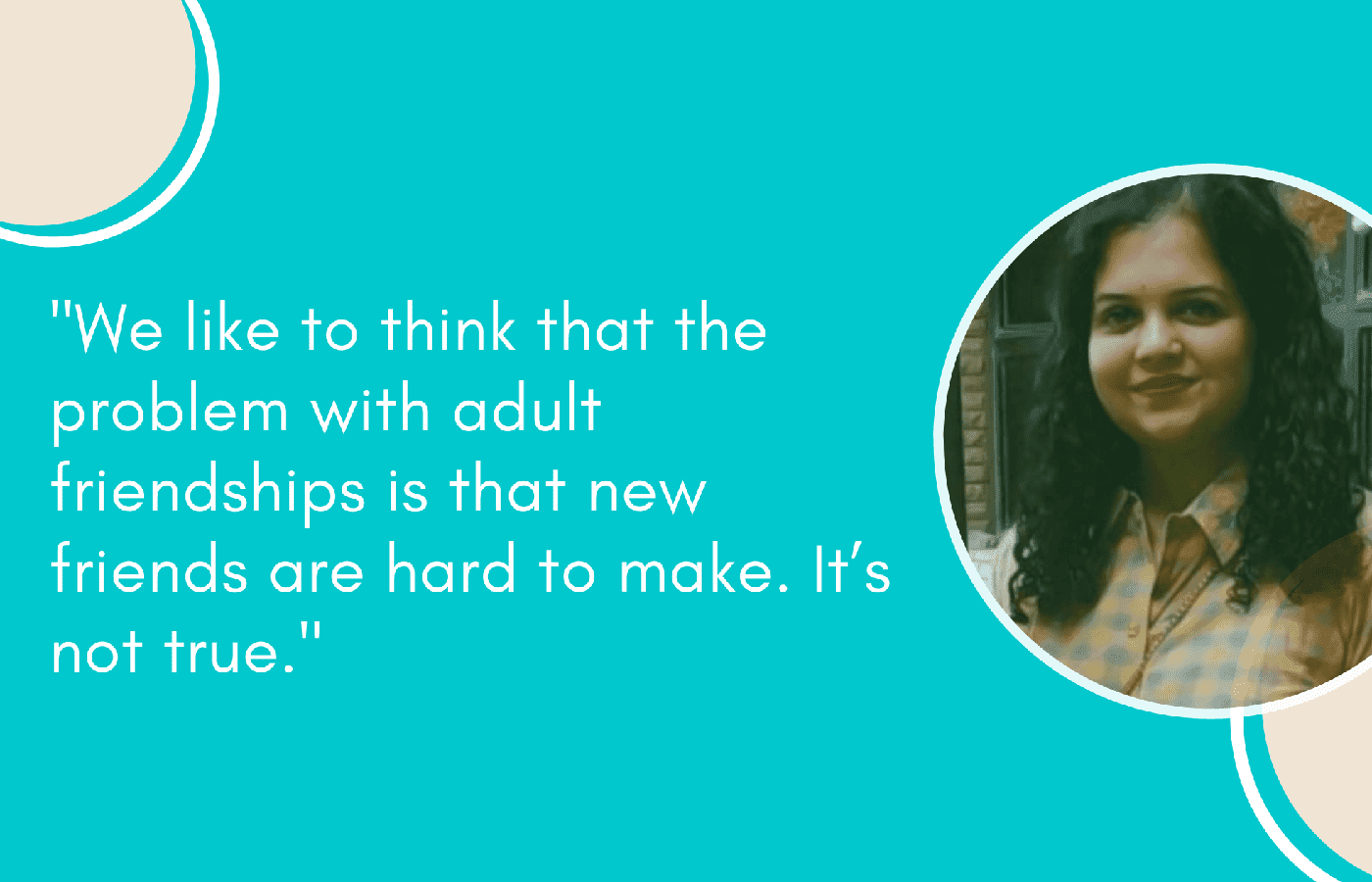
We like to think that the problem with adult friendships is that new friends are hard to make. It’s not true. We have Facebook groups, Twitter threads, workshops, whether online or offline, guided walks in the city, and mutual connections. It’s not that we’re so calcified with age that we need friendships less (ask the laughter club in your neighborhood park that’s resumed its morning ‘exercises’). It’s that when the basic boxes of career, partner, and children have been ticked for most of us – friendships can become entirely optional. And that’s why they end.
The least chosen items get taken off the menu, right?
Disclaimer: The views expressed above are the author’s own. They do not necessarily reflect the views of MyndStories.