In October 2015, a 17-year-old boy named AG (name changed for privacy) walked into the clinic of Dr. Naresh Gupta, a psychiatrist based out of Hisar, Haryana. AG was accompanied by his mother, who complained that AG was not how he used to be anymore. He was irritable and constantly got into fights with his friends. He had stopped going to college.
Dr. Gupta asked AG’s mother to step out of the office for a while so he and AG could have an honest conversation.
“What has been on your mind recently?” the doctor asked.
“Nothing at all. My mom is just making it all up. I am completely fine. This is just how I have always been,” replied AG angrily.
Dr. Gupta had heard these lines before. Not from AG but from other adolescent boys who had been brought to his clinic by concerned parents.
Dr. Gupta prescribed AG low-grade antidepressants and asked him to visit the clinic again next week. AG never returned.
While AG’s mother and Dr. Gupta stayed in touch, AG vehemently opposed visiting a mental health professional again.
Masculinity and help-seeking behavior in men
Over the last few decades, a growing body of empirical research has tried to understand the differences in the frequency with which men and women seek professional help. They have found that irrespective of age, nationality, race, religion, and economic status, men seek professional help less frequently than women (Addis & Mahalik, 2003)
The frequency of help-seeking behaviors is often in stark contrast with the rate at which medical, particularly psychiatric issues, afflict men. As per a study from 2021, men have a lower average life expectancy than women in every state of India. According to the Accidental Deaths and Suicides in India Report published by the National Crime Records Bureau in 2021, men accounted for 72.5% of all suicides in India, an increase of 2.4% age points from 2020 (70%).
As a report from Switzerland morbidly observed in its study on suicide prevention in the country, “Women seek help – men die.” (Angst and Ernst, 1990)
There is a discrepancy in health issues, particularly mental health issues, that men face and the frequency with which they seek help for the same. AG, the young boy that Dr. Gupta treated, is an embodiment of the discrepancy.
While it is obvious to his parents that there are some unseen issues that he is going through, AG is stubborn in his resistance to any form of external help. In such a situation, it is easy to blame AG for his own predicament.
If he wants to get better, all the help in the world is available to him. Why is he stopping himself from accessing this assistance?
Much like everything else in life, the answer is never that simple.
‘Mard ko dard hota hai?’ Do men feel pain?
In 1985, Dara Singh, playing the role of Raja Azad Singh, carved the word “mard” into his newborn son’s chest. The newborn never let out one tear while being carved by a knife by his own father.
Dara Singh proudly claimed, “Mard ko dard nahi hota” (A man feels no pain), and the words have been immortalized ever since. While the phrase has become a satirized version of itself in modern India, the idea that men are not expected to feel pain still prevails.
Indian society is very clearly demarcated when it comes to gender roles and expectations. Men are traditionally expected to be the breadwinners, while women are expected to be the homemakers. According to a survey by the Pew Research Centre in 2022, 43% of Indians believe that earning money is primarily the responsibility of men, although 56% believe that both men and women should contribute to the house’s finances.
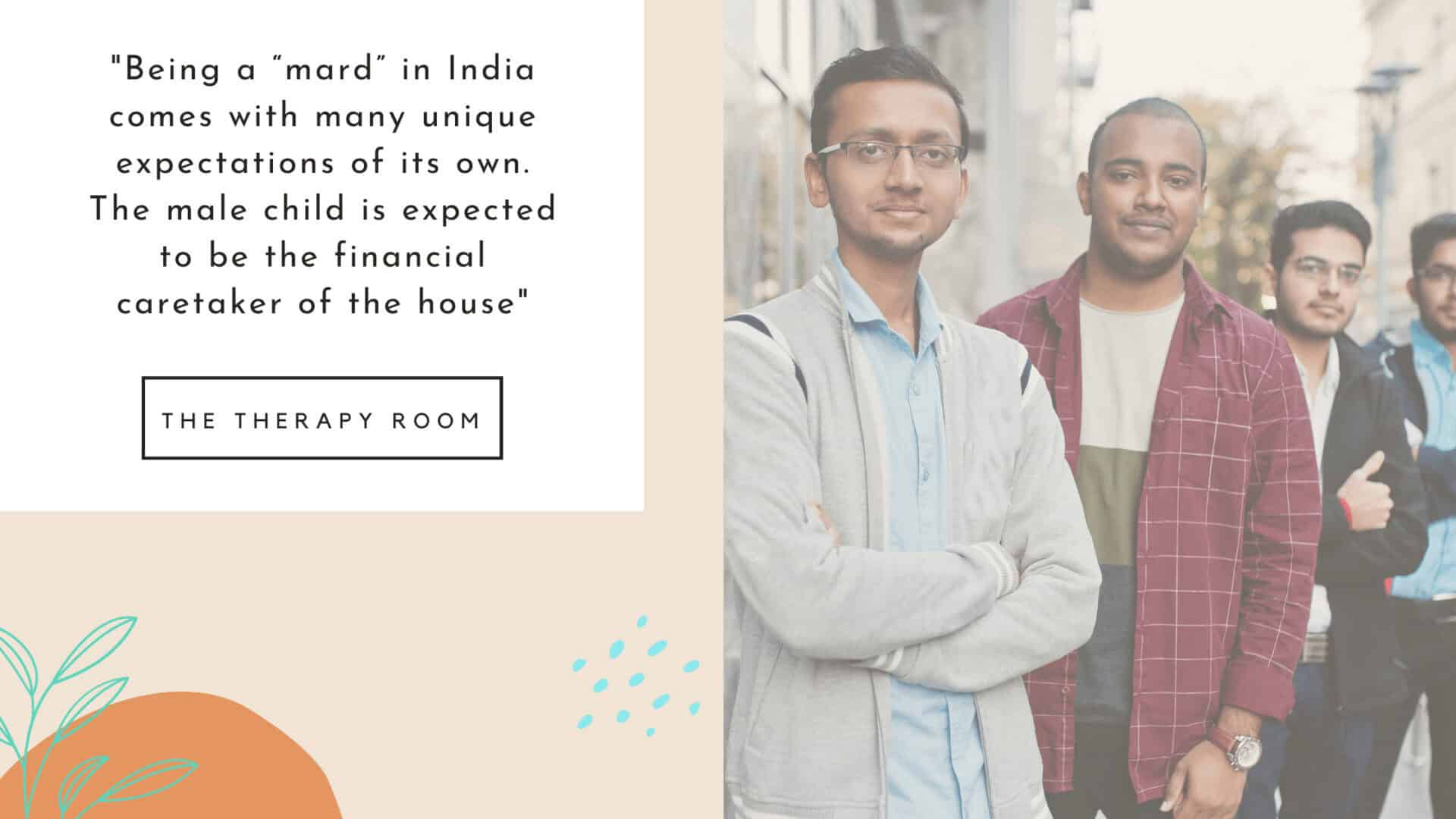
Being a “mard” in India comes with many unique expectations of its own. The male child is expected to be the financial caretaker of the house in the future and the primary breadwinner in the family.
The profile of an ideal man, as described by Thomas and Pleck (1986) centers around being physically, emotionally, and financially self-reliant, achieving status (respect of peers), and active avoidance of traits that might be considered feminine (such as emotional care for others, empathy, and sensitivity)
AG, the young boy, should be considered a product of the culture and society in which he was brought up instead of the sole driver of his own life. 17 years of socialization which stressed not seeking help, keeping emotions in check, and being self-reliant, cannot be overcome in a few moments in the doctor’s clinic.
When he says, “I am completely fine. My mom is just making things up,” it is not “him” talking. It is his society talking through him.
When it comes to help-seeking behavior in men, the major barriers they face are cultural and social. (Nielson, Singh, Harper & Teng, 2020) While relying on a traditionally masculine perspective of health and the body, men see their bodies as functioning machines that should be given care only when necessary. For them, being healthy is not being ill. (Moller-Leimkuhler, 2002) This viewpoint also generalizes to men and mental health.
Men experience illness, especially any form of mental disorders, as a threat to their masculine identity (Williams, 2000) since weakness and requiring help are not masculine traits. This leads men to double down on their own struggles and not even admit that they might be experiencing any form of physical or mental distress.
Making mental health accessible for men

Once the social and cultural impact of masculine norms on young men is understood, it becomes important to understand how this knowledge can be used to make mental healthcare accessible for young men in a way that would not be seen as a threat to their masculine identity.
Mark Kiselica and Matt Englar-Carlson (2010) propose using the positive masculinity framework in the therapeutic space to engage boys and men in therapy better. This framework adapts the therapeutic process as per masculine norms to focus on self-improvement and bonding through shared activity to build rapport with the clients.
The positive masculinity framework would not ask AG what was wrong with him. It would try to build a bond with him. Engage in some activities to build a bond (such as playing a PS5, building a LEGO set, etc.) and affirm the strengths that come with masculinity to ensure he never feels his masculinity is being attacked or modified.
The work of influential psychologist Lisa F. Barrett has also been adapted to improve emotional health in men. Barrett (2004) proposed the concept of ‘emotional granularity,’ which is the precision with which an individual can label their own emotion in a particular context. The concept has since been adapted to improve engagement in therapy, particularly with men.
Being able to label one’s own emotions accurately has been linked with better social functioning (Kimhy et al., 2014) and better emotional regulation strategies. (Barrett and Gross, 2001)
The first step in communicating any form of emotion is understanding what emotion we are feeling in the first place. Improving the emotional vocabulary of men is an important first step in helping them access mental health services.
Following up on AG
“Asking for help” is easier said than done, especially for men. The help-seeking ideal might be seen as an assault on masculinity for men who subscribe to the traditional masculine norm of self-reliance in every sphere of life. Collective social action, which embraces the positives of masculinity and reframes its shortcomings, is needed to improve the state of men’s mental health in India.
What happened to AG from 2015 on? Did he get better or ever get the help he needed? Thankfully, we have the answers to these questions. In 2017, AG reported the problems he was going through for the first time to a professional.
This allowed the devising of a more effective treatment plan which showed clear results in 6 months. Fascinated by the therapeutic process, he decided to pursue a career in clinical psychology and is a practicing counseling psychologist today.
He has also been working on men’s mental health to help other young men who may be feeling lost like he did all those years back. Also, he is the author of this article 🙂
References
Addis, M. E., & Mahalik, J. R. (2003). Men, masculinity, and the contexts of help seeking. American psychologist, 58(1), 5.
Barrett, L. F. (2004). Feelings or words? Understanding the content in self-report ratings of experienced emotion. Journal of personality and social psychology, 87(2), 266.
Barrett, L. F., Gross, J. J., Mayne, T., & Bonnano, G. (2001). Emotion: Current issues and future directions. New York: Guilford, 286-310.
Kimhy, D., Vakhrusheva, J., Khan, S., Chang, R. W., Hansen, M. C., Ballon, J. S., … & Gross, J. J. (2014). Emotional granularity and social functioning in individuals with schizophrenia: an experience sampling study. Journal of psychiatric research, 53, 141-148.
Kiselica, M. S., & Englar-Carlson, M. (2010). Identifying, affirming, and building upon male strengths: the positive psychology/positive masculinity model of psychotherapy with boys and men. Psychotherapy (Chicago, Ill.), 47(3), 276–287. https://doi.org/10.1037/a0021159
Möller-Leimkühler A. M. (2002). Barriers to help-seeking by men: a review of sociocultural and clinical literature with particular reference to depression. Journal of affective disorders, 71(1-3), 1–9. https://doi.org/10.1016/s0165-0327(01)00379-2
Neilson, E. C., Singh, R. S., Harper, K. L., & Teng, E. J. (2020). Traditional masculinity ideology, posttraumatic stress disorder (PTSD) symptom severity, and treatment in service members and veterans: A systematic review. Psychology of Men & Masculinities, 21(4), 578–592.
Thompson, E. H., Jr., & Pleck, J. H. (1986). The structure of male role norms. American Behavioral Scientist, 29, 531–543. http://dx.doi.org/10 .1177/000276486029005003
Williams, C., (2000). Doing health, doing gender: teenagers, diabetes and asthma. Social Sci. Med. 50, 387–396.