
“There’s a saying that people with BPD have “emotional skin” like a third-degree burn, and it’s true.”
“Life is tough, but I’m tougher,” says Suvechha Roy, a math graduate from Presidency University, Kolkata. Suvechha has taught at Byju’s and SATnpaper and was diagnosed with Borderline Personality Disorder (BPD) at 21. Today, confronting the stigma around mental illness head-on, she’s turned her personal struggles into a powerful mission: to raise awareness through her writing.
Her debut novel, “Heal Your Wounds with My Love,” is making waves, and she’s soon to release a short story, “Down the Memory Lane.” Through her work, Suvechha aims to spark conversations about mental health, inspire others to seek support, and show that despite adversity, there’s hope and strength to be found.
MyndStories spoke with Suveccha to explore her journey, obstacles, and strategies for overcoming them.
How did you first get diagnosed with BPD, and what was that experience like for you?
At 18, I started experiencing anger outbursts and told my family I needed to see a psychologist, but they didn’t take it seriously. A year later, I began having severe panic attacks that led to hospitalization. The doctors assured me it was just panic attacks and nothing life-threatening, which made my family less concerned.
Over time, I was diagnosed with anxiety and depression. After a fight with my family, I decided to live alone with only 40,000 rupees in my account and no other support. I noticed my moods fluctuated drastically, sometimes feeling independent and strong in the morning, only to feel lonely and suicidal by evening. This was my first real understanding of how quickly my mood could change.
I shared these mood swings with my doctor, especially since my father had been diagnosed with acute bipolar disorder. Initially, they thought I might have bipolar disorder, too, but after a week of observation, they concluded that I did have BPD. The diagnosis was shocking, and the societal stigma made it difficult to accept.
While both bipolar disorder and BPD involve mood swings, they differ significantly. Bipolar disorder is a mood disorder where mood swings can last for weeks or months, with phases of mania and depression. In contrast, BPD, a personality disorder, involves rapid mood swings that can change within minutes or hours.
On a daily basis, my mood swings occur regardless of how my day is going. Even on a “normal” day, I experience mood fluctuations, though their intensity can vary. Sometimes, I manage without an SOS, while other times, even minor triggers like a fight can cause extreme emotional responses. This constant emotional turmoil is why I realized a traditional 9-to-5 job isn’t for me.
What are some of the biggest challenges you face as someone with BPD on a day-to-day basis? How has it affected your professional and personal relationships?
Professionally, I’ve switched jobs frequently—probably around 10—because stability is hard to maintain when you have BPD. I’ve even been fired a few times when employers found out about my condition. In the corporate world, mental health is often overlooked; what matters is whether you’re performing.
After working at places like Byju’s, Satin Creditcare, and various schools, I realized that corporate jobs aren’t for me. Writing allows me the flexibility to take breaks when I’m not feeling well and return when I’m ready.
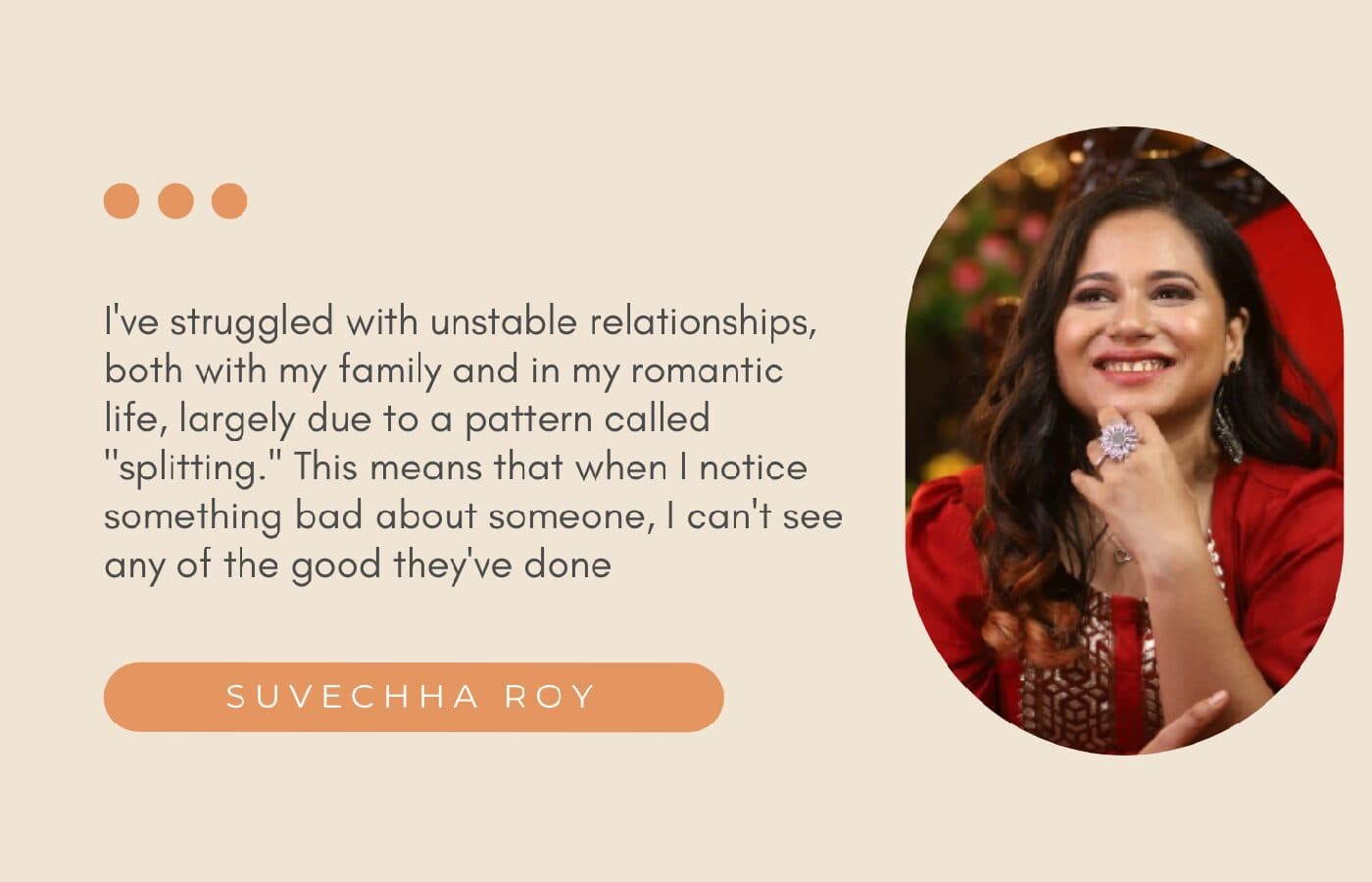
On a personal level, I’ve struggled with unstable relationships, both with my family and in my romantic life, largely due to a pattern called “splitting.” This means that when I notice something bad about someone, I can’t see any of the good they’ve done. I shift from love to hate very quickly, which understandably affects relationships. Not everyone can grasp that I’m going through an episode, and this leads to complications.
But I’m finally in a stable relationship. I’ve been with my husband for over two years, which is significant for someone with BPD. He understands my mood swings and splitting, which has made all the difference. I feel incredibly fortunate to have found someone who truly supports me, especially when even my family struggles to understand what I’m going through.
How does your husband manage the ups and downs of the relationship, given the challenges of BPD?
My husband proposed to me while I was in the hospital. It showed he truly understood and cared, even when most people would have run away. He has his own experience with depression, so he gets mental health challenges on a deep level. He might not fully understand everything I go through, but he knows I’m struggling and stands by me.
How do you handle extreme mood swings in social events?
I take both medication and therapy since my symptoms are quite severe. A few days ago, my doctor even suggested electroconvulsive therapy (ECT) due to the intensity of my depression and anxiety, but fortunately, the medication started to help before that was necessary.
Dialectical Behavior Therapy (DBT), developed by Marsha Linehan, who also has BPD, has helped me a lot. Through DBT, I’ve learned to categorize my feelings into different zones—green, yellow, and red, like a traffic light. In the green zone, I write or read to calm myself. If I move to the yellow zone, I try expressing my feelings through drawing or taking a bath to relax. But if I hit the red zone, where things feel unbearable and suicidal thoughts creep in, I take my emergency medication and sleep. Sometimes, that’s the only way to get through those intense phases.
When I feel a mood swing coming on, and I’m not home, I take my SOS medication immediately. It’s a high-dose sleeping pill, so I can just say I’m feeling sleepy, and no one questions it. Sometimes, even the medication doesn’t completely work, but in those moments, I have to rely on it because it’s a chemical imbalance in the brain.
It’s different when I’m at home—I have more control over my environment. But it’s much harder to manage when I’m out, like in my art class or on the way somewhere. I can easily be triggered by someone’s words or reading the news, so I avoid those triggers. I only talk deeply with people who understand and won’t trigger me.
It’s tough because those low moments feel like losing a loved one—deep, painful, and all-consuming. There’s a saying that people with BPD have “emotional skin” like a third-degree burn, and it’s true. The emotional pain can be excruciating, so knowing how to manage it is essential for survival.
On the positive side, I’ve become a good listener and can empathize deeply with others. People often open up to me about their mental health, which I see as a meaningful achievement.
How has your life changed after your diagnosis?
BPD has brought positive changes to my life. One of the most significant is hyper-empathy. I deeply empathize with others, sometimes to the point where it affects my own well-being. For instance, reading about something traumatic in the news can hit me hard. But this heightened empathy also means I can connect with others and make them feel understood and supported.
Another positive trait is creativity. Like Vincent Van Gogh and Edvard Munch, people with BPD are often highly creative. My creativity blossomed after my diagnosis, leading me to write fiction focused on mental health. My goal is to help others understand mental health issues and recognize the signs in themselves or those around them. Writing has become a way for me to make a small but meaningful impact.
What is the biggest misconception about BPD?
The biggest misconception about BPD is that we’re attention-seeking and manipulative. When someone with BPD expresses fear of abandonment or talks about self-harm during a conflict, it’s often misunderstood as manipulation. But in reality, these feelings and threats are genuine and deeply felt, an expression of real distress.
What steps can society take to better support individuals dealing with BPD or other mental health issues?
To really support people with BPD or other mental health issues, we need to start early. A childhood where children grow up in safe environments free from abuse or trauma. Schools should be more aware of how these early experiences can impact mental health and take steps to help children.
For those who are already dealing with mental health conditions, offer empathy and understanding. Just letting someone know it’s okay not to be okay and listening to them without judgment can make a huge difference. It’s also important to have open conversations about mental health and work to break down the stigma.
We have two eyes, and if one eye is physical health, then the other is mental health. You cannot expect to see with one eye, right? So you have to take care of your mental health as well as your physical health, which we don’t do.
On a personal level, activities like gardening or caring for pets can be incredibly helpful. They create a sense of responsibility and routine, which can be very grounding and therapeutic.
My two dogs, along with the rest of my animals—one rabbit, two birds, one fish, and a lot of plants—really help me. They provide comfort and a sense of responsibility. Even on tough days, feeding and caring for them gets me out of bed and helps me stay grounded. I’m helping them, but in reality, I’m also helping myself.
For someone newly diagnosed with BPD or another mental health condition, what advice would you give to help them manage their condition and find effective coping strategies?
If you’ve just been diagnosed with BPD or another mental health condition, it can feel overwhelming. Read books and articles from mental health professionals. Refer only to credible sources.
Acceptance is key. Knowing that many people go through similar struggles can help you come to terms with your diagnosis. Without acceptance, it’s challenging to engage fully in therapy, even if a professional is guiding you.
Therapy and medication can make a big difference. Look into group therapies, too—they can provide support and education.
Lastly, remember there is hope. While the journey might be tough, many people manage their conditions and lead fulfilling lives. With time and the right support, you can learn to manage your symptoms and find a path forward.
You write about mental health disorders and use fiction to raise awareness. How do you gather insights for your writing—do you interview people with mental health conditions or use other methods?
For my writing on mental health, I first read books and articles by professionals to gain a solid understanding of various disorders. I also consult with my psychologist to ensure that the information I include is accurate and avoids the negative portrayals often seen in thrillers.
Beyond professional resources, I gather insights from personal interactions.
When people learn about my experience, they often open up about their mental health journeys. For instance, a friend I made in Bangalore shared his experience, which influenced my second book.
I feel honored and grateful when people share their stories with me. These personal connections enrich my writing and help me create more authentic and relatable content.
What keeps you going during tough times? Is there a particular belief or philosophy that helps you stay positive and resilient? What tells you it’s okay, it’s not over yet?
It’s about recognizing that tough phases are just that—phases. While the intense emotions can be overwhelming, they also make the moments of joy more meaningful. It’s all a part of the journey.
Life can be hard, but I am harder.