The American Psychological Association defines trauma as “an emotional response to a terrible event like an accident, rape or natural disaster”. Trauma, however, is much deeper than that with short and long-term physical and emotional effects.
Emotional symptoms of trauma include denial, anger, sadness, and emotional outbursts. Physical symptoms include paleness, lethargy, fatigue, poor concentration, and a rapid heartbeat.
The National Council for Mental Wellbeing reports that over 70% of adults have experienced trauma at some point in their lives.
Here, we will look at an ancient Chinese holistic wellness system called “Qigong” and its role in treating trauma.
Trauma and the body-mind connection
Many of us are familiar with the three common responses to trauma: fight, flight, or freeze. There are, however, two lesser-known responses to trauma: “flop” (submission), and “friend” (crying for help).
Trauma expert Janina Fisher, Ph.D., describes some of these survival defences as below
“…the panicky alarms of a fearful part (freeze) can alert the individual to danger; a playful part might try to lift the parent’s irritable mood and facilitate a positive connection by making him laugh (social engagement); a caretaker aspect of self (submission) can become the precociously responsible child who tries to protect herself or younger siblings in the face of the violent behavior; or a hypervigilant aspect of self (fight) may become a kind of bodyguard…”
In addition to these five responses, and “classic” trauma symptoms such as flashbacks and nightmares, the body often responds with physical pain, trembling, and shaking.
Unreleased action energy from trauma gets stuck in the body and often manifests as chronic pain, chronic stiffness, or other physical symptoms according to psychologist and trauma expert Peter Levine.
Levine explains the process of how this energy gets discharged during a therapy session, a process that later inspired him to write his bestselling book “Waking the Tiger”. When in a therapy session, shaking or trembling is perfectly normal – even healthy – as the body releases that pent-up energy. Muscles contract during a traumatic event, and they often stay contracted during prolonged periods of stress or anxiety long after the event has passed.
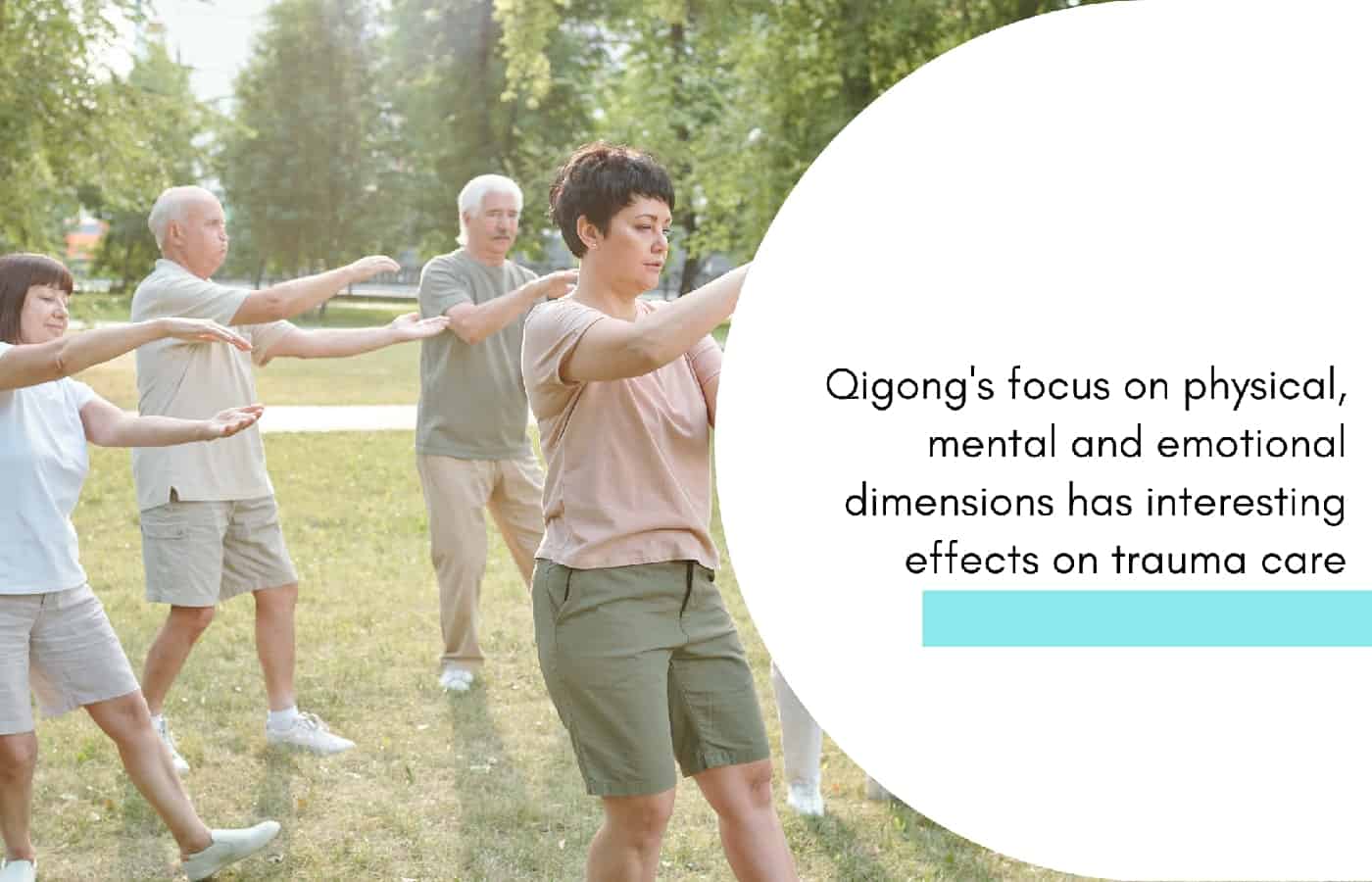
The Chinese system of wellness, Qigong, is based on this body-mind connection, and its focus on the physical, mental and emotional dimensions with mindful breathing has interesting effects on trauma care.
Qigong and mental health
Qigong is a mind-body practice from one of the five branches of ancient Chinese medicine. The process involves a combination of slow, fluid movements involving the body, breath, and mind.
The “Qi” in Qigong (pronounced CHEE) refers to “vital energy”, similar to “prana” or “life breath” in Indian systems of yoga. “Gong” means “skill”. The word loosely translates to “the skill of mastering your vital energy”.
“The purpose of Qigong is not to strengthen your core muscles or become more flexible – though that’s a nice side benefit – but rather to strengthen the mind and increase one’s energy reserves”, says Qigong teacher Nick Loffree.
Research demonstrates with consistent, significant results that Qigong directly impacts anxiety, depression, stress, mood, and self-esteem.
Qigong and trauma
The mind-body-breath connection that is central to Qigong is of particular interest for addressing trauma.
A research paper on the effectiveness of Qigong and other alternative medicine practices in treating survivors of torture and refugee trauma says: “…Qigong and t’ai chi effectively provide relief for many physical and psychologic ailments in the general population, including those that also are suffered by survivors of torture”.
In this article, Bill McMillan is a marriage and family therapist, speaks to the efficacy of Qigong in treating trauma and anxiety. He reminds us that Qigong is not meant to be used as an alternative to western medicine practices but as a safe addition.
Cancer is one of the contexts where trauma care is crucial for recovery. Getting diagnosed with cancer comes with immense mental trauma, and treatment comes with further trauma for both the body and the mind.
Australian osteopathy expert and Qigong trainer John Walsh explains how Qigong helps with cancer trauma management.
“The first thing people notice when they begin to practice Qigong is that it calms them.” John says, and adds: “As stress and anxiety reduce, focus increases, and we begin to feel more at home in our bodies.”
Cancer survivor Alyssa Sybertz says Qigong helped her heal from trauma. Alyssa was hooked after just three days of Qigong. She describes how practicing Qigong gets her more in touch with everything going on inside her, tearing down barriers between her mind and body.
Qigong for trauma relief in India
In India though, the use of Qigong for therapy, particularly for trauma relief, is yet to find traction. Mental health in India is a growing concern with rising population levels and stressful lifestyles, and this is a good time to look at resources available for Qigong resources that can help.
Most major cities in the country have Qigong and Tai Chi workshops, but few focus on trauma relief aspects.
Vital Force Tai Chi Academy
Source: Vital Force
Vital Force Tai Chi Academy is among the few organizations in India that focus on trauma relief using Qigong. It is run by Cicily Thomas, a certified Qigong master, and somatic experiencing practitioner.
She trained in China under Grand Master Fu Sheng Yuan and Master Fu Qing Quan, who represent the fifth and sixth generations of the Yang family.
“For several years, I explored and practiced techniques including vipassana and zen, yoga, tai chi chuan, Qigong, counseling, NLP, Gestalt therapy, cranio-sacral therapy, traditional Chinese as well as ayurvedic acupressure. I have drawn in the essence of ancient wisdom from these practices and blended them with the modern-day holistic healing approaches.” says Cicily.
Write to Cicily here – vitalforcetaichi@gmail.com
Sevangee
Source: Sevangee
Sevangee is another Indian organization that focuses on the healing aspects of Qigong, especially long-term training courses for aspiring Qigong healers.
It is run by Christopher Fernandes who has over 40 years of experience in the field of internal body training, Chinese martial arts, and physical training.
Sevangee separates their Qigong programs meaningfully into “medical Qigong”, “martial Qigong” and “spiritual Qigong”. Their medical Qigong program is divided into 9 levels as follows:
- The first three levels focus on theory and training
- The second three levels are centered around diagnostics
- The third three levels deal with healing
Write to Sevangee here – info@sevangee.com
Tai Chi Qi Gong, New Delhi
Tai Chi Qi Gong , New Delhi, runs Qigong workshops focused on health and healing.
Their workshops are taught by Alexandra Reelick who was born in the Netherlands and studied fine arts and western philosophy. Alexandra studied Tibetan Buddhism, ancient philosophies, ancient medical systems, and healing therapies. She has traveled extensively to China, Tibet, and the Himalayas. She works in New Delhi where she has been living for 25 years.
Her healing-focused workshops are divided into three broad areas:
- Balance: breath-body alignment
- Healing: awareness, earth qi, Taoist cosmic flow
- Harmony: communication, transmitting qi, infinity movements
Write to Alexandra here – taichiqigonghealing@gmail.com
Resources to get started with Qigong for trauma
Here are a few resources to get started with Qigong for addressing trauma. Qigong is best learned directly from a master, but these videos can help get a taste of how the fundamentals work and how they can help with trauma relief.
Janice Tucker
Qigong & Chinese medicine practitioner Janice Tucker shows us how to practice Qigong for trauma release and shock.
Chris Shelton
Chris Shelton is a speaker, author, and healer practicing traditional Chinese medicine. He shows us how to use Qigong for addressing trauma, shock & PTSD.
Qigong, like Tai Chi, yoga, and other systems that focus on the mind-body connection and mastery of life-breath, are still areas mostly unexplored by modern science.
We hope to see more of both scientific and experiential research into holistic methods that apply mindfulness techniques that help us all fight our battles with more aligned bodies, minds, and life energies.