“For me, it’s always about creating spaces where people can feel safe and authentic while exploring their emotions.” – Srinithi Sridhar, Counseling Psychologist
How do you find the lights of safety and comfort when you’re navigating through the dark, unsettling tunnel of emotions that feel nothing but scary in moments when you can’t see beyond them?
The freezing in a loop of negative thoughts and emotions that can arise from experience is what we call trauma.
In this piece with Srinithi Sridhar, a counseling psychologist, we understand what trauma means, how it actually feels to experience trauma, and how Srinithi works with her clients to make them feel safe and authentic as they explore their emotions.
You are a practicing therapist now. But have you always known that you wanted to get into the mental health space?
I’ll be very honest, growing up, mental health was a non-existent topic. I was gearing up to crack the IIT from the 9th grade and was hell-bent on getting into IIT. But questions like, ‘Why aren’t people nice to each other?’ ‘Why aren’t people nice to themselves?’ used to buzz in my mind.
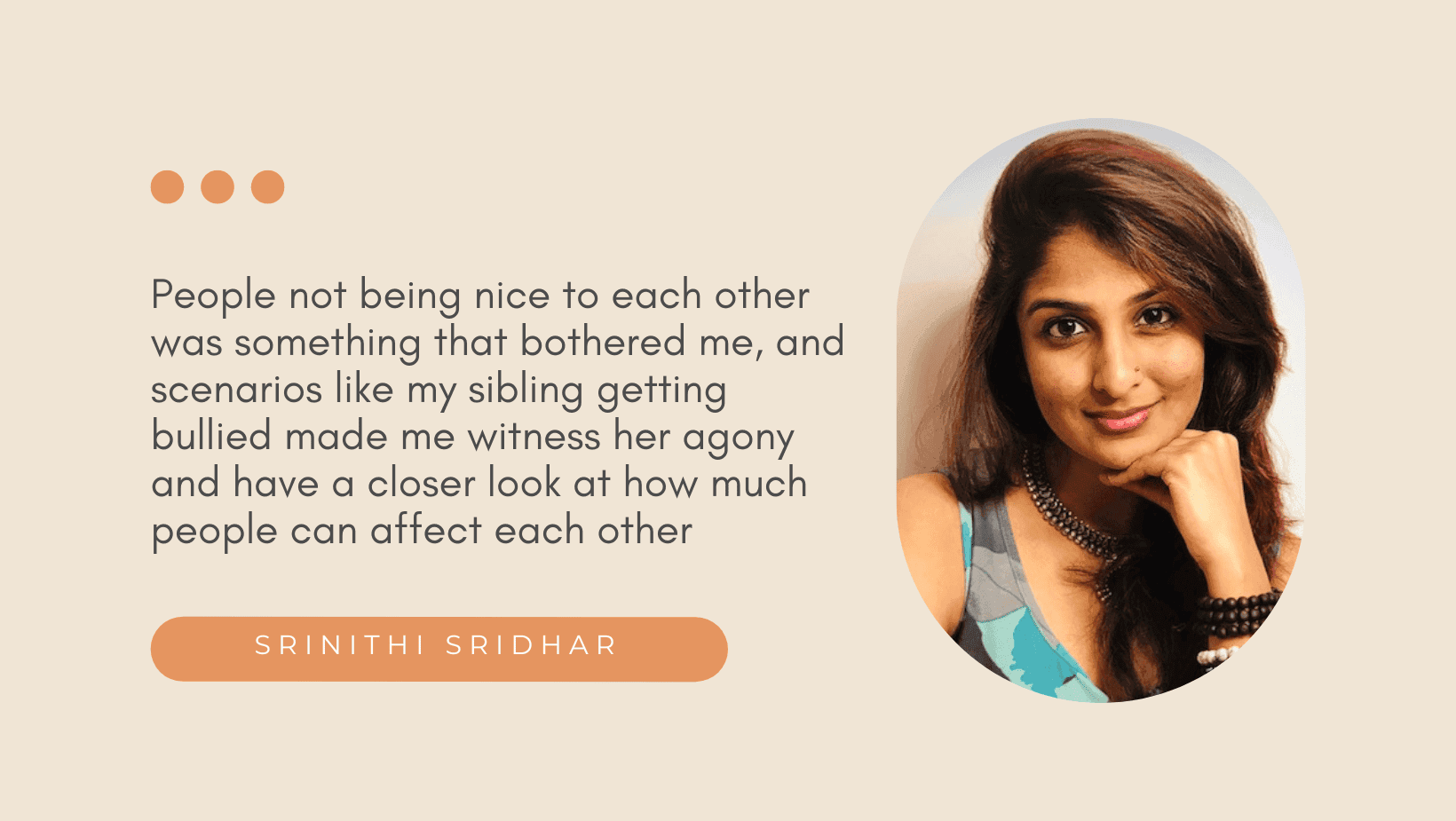
People not being nice to each other was something that bothered me, and scenarios like my sibling getting bullied made me witness her agony and have a closer look at how much people can affect each other.
During my 4-year intensive preparation for the IIT entrance, I realized that topics like trigonometry and algebra are not something I would be able to use every day. It was at this point that I decided I wanted to pursue something I could incorporate into my own life every day.
I had been a dancer throughout my childhood, and dance had always put me in a pleasant mood which I missed when I couldn’t dance in my 11th and 12th during my IIT prep. I’ve also always had a fascination with literature.
So my background in Performing Arts, and the will to see a world where people are kinder to themselves and those around them, made me choose a degree that was centered on Performing Arts, English, and Psychology for my graduation.
My degree in Counseling Psychology taught me how to hold space for heavy emotions that sprung from being stuck in a negative-thought loop which helped me understand the depth, intensity, and root of an emotion.
What is the kind of work that you have been involved in lately?
I have my private practice where I work with clients who are over the age of 18. I help them with relational dynamics, which could involve their relationship with a spouse, a parent, a friend, or their relationship with time, stress, or even the political scenario.
‘In a nutshell, my work explores relationships of people with themselves, with others, and with situations.’
I urge my clients to explore the various intersections of their life because we play a multitude of roles in our lives where our cultural, sexual, and economic backgrounds form the backdrop of our experiences.
Working with me is collaborative, where I believe in creating an introspective and reflective space.
Apart from my private practice, I have also run a support group for the queer community and conducted workshops on hetero-nomic relationships, navigating the queer timeline, and queer relationships. I also run a support group for people who have been starting a new life for themselves, be it by moving to a new place or shifting careers, etc.
What can people expect when they work with you?
For me, it’s about creating spaces where people can feel safe and authentic.

At an individual level, the goal is to make people feel safe while they’re exploring their emotions.
So I’m working with people and urging them to explore safety in their own bodies because when you don’t feel safe, then you could have a pit in your stomach or a fast heartbeat which comes from the fact that people are not comfortable in their skin.
This is what I aim for, even in support groups. I try to create a space where people feel comfortable and empowered to speak up.
On a community level, I aim to do many more desensitization sessions and talk about inclusion, diversity, equity, and consent at work to bring about awareness and take this to the strata of leadership as well.
I hope to speak to leaders so that they get empowered to make their workplace safe for their employees. It is always about safety, empathy, and authenticity for me.
You are also trained in trauma-informed care. We hear the word ‘trauma’ used a lot on social media. But what is trauma really, and how does therapy help?
So trauma is a place where a person gets frozen in time or in a particular experience, so much so that they don’t see beyond it.
In trauma-informed care, the neurobiology and the different stress responses that arise within us are addressed. The stress response could be fight, flight, freeze, or fawn.
Our stress response could be any of the above four, but when a person freezes in time due to past, present, or future stress, that’s when it becomes traumatic.
Through trauma-informed care, we give language to both the wounding process and the healing process, making it much easier to feel it in their body, process, navigate and articulate how we respond to stress.
I use a technique called the ‘EFT- Emotional Freedom Technique,’ which is like acupuncture, where the points of nerve endings in the body are tapped on so that the energy is released in that distressed area.
One of the things in trauma-informed care is that the body remembers a lot which is why I get my clients to move, be it through coloring or simple releasing movements like unclenching their jaw or loosening their shoulders because often our stress gets trapped in our joints causing them to become rigid.
Apart from trauma-informed care, you also work in what is called ‘queer affirmative care.’ Again, this is coming into its own. There are a lot of therapists who call themselves ‘queer-affirmative.’
Since high school, I have worked with several NGOs involving a lot of volunteering work because working with marginalized communities is very dear to me.
The queer community is a spectrum where people rarely talk or are even aware beyond the meaning of L and the G in LGBTQAI.
The goal of ‘queer affirmative care’ is to be more mindful and informed of addressing the queer community where instead of coming from a place of conditioning, you come from an informed and empathetic place.
When you’re queer-friendly, you may still not be able to understand the spectrum, but if you’re queer-affirmative, then you would be more willing to have conversations around it and, in turn, become more informed about how to respond to anyone exploring their sexuality.
Recently, you also started work as a trainer with Mitti Cafe, a chain of cafes across India that creates employment opportunities for people with disabilities. What kind of work have you been doing at Mitti Cafe?
I am a soft skills trainer, and I work with people with disabilities over 18 years of age at Mitti Cafe. I train them for their professional career on skills like communication, identifying strengths and building on them, how to work in a team, how they should groom themselves, how they should handle money, and make them aware of good touch and bad touch so that they can stand on their own feet.
What has your biggest professional learning been?
To be patient. Because therapy is a space where you deal with people, and each person is unique, no one fits in the mold of what is perceived of them.
Especially the depiction of therapy in movies, it is shown that the solutions to problems are found, and the process is linear and spontaneous. But in reality, you could go from A to B with the client, but they could go back to A. At such times, it helps to check in with the client and see if the process is working for them.
Initially, I used to question if the process was going right, but now I am more patient with the client and myself. Because that is how I am allowing people to open up in their own time to know themselves until the sense of safety settles in with their own body and mind.
I say this because the process of therapy is very layered, and listening is never a passive activity because you have to understand by tapping into the clients’ emotions and helping them make sense of it.
I have now gathered enough experience to know at what point we could ask the client to help them become more aware of what they’re feeling and where it’s coming from.
If you need to reach out to Srinithi, you can contact her at www.blueheartswellness.com or write to us at content@myndstories.com. Srinithi is one of our certified Reviewers.