

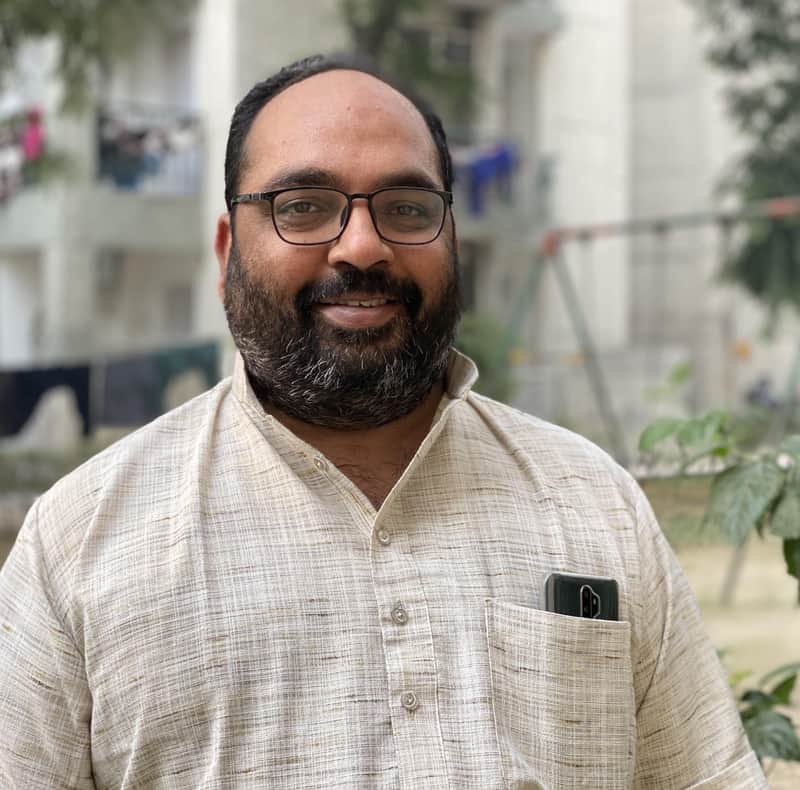
“Sometimes, my behavior patterns and responses come from the ruins.” – Amandeep Sandhu
A quiet peace permeates author and journalist Amandeep Sandhu’s voice. It’s the quiet peace of an adult life that has come to terms with a life built on the chaos of childhood. The Punjabi writer, whose novel Roll of Honour was nominated for the Hindu Literary Prize for Best Fiction back in 2013, uses words with care – care that comes from a lifetime of dealing with the impact of words.
Born in Rourkela, Amandeep has lived in different parts of India, and that quiet that characterizes him is often shattered by his fierce advocacy of mental health. Amandeep wrote the haunting Sepia Leaves as a semi-autobiographical novel based on his childhood, growing up with his mother, who lived with schizophrenia. Published in 2008, Sepia Leaves is a story of survival and a penetrating look at human frailties, vulnerabilities, flaws, weaknesses, and yes, love too. As eight-year-old Appu, Amandeep writes about how it felt to be on the fringes of a narrative that didn’t consider him and his family normal. Appu loathes that he “hated that people pitied me because I did not have a normal family. I wanted friends and neighbors to accept me as an equal, not as someone to be pitied.”
For Amandeep, his childhood experiences shaped him into the writer he is. Amandeep confesses that he writes a lot – writing that is almost cathartic, helping him to dig deep into the experiences that shaped his childhood. He uses writing to understand the world around him and within him—those walls around us and the bricks and edifices of the human mind. But understanding when it comes to mental health is often a huge bridge to cross. Amandeep admits as much.
Mental health: then and now

Amandeep set Sepia Leaves in the 1970s – when mental health was a closed, closeted world, locked up in the closets of shame and stigma. These days, there’s a more embracing feel around mental health in India. There are more conversations. More initiatives. More startups rushing to offer help and support to those who need it. Yet, despite the increase in conversations, Amandeep thinks that families still haven’t found a way out of dealing with the implications of mental illness. “The problem is, many are talking, but who’s listening? People tend to stigmatize concepts that are beyond their understanding. And worse, they then start othering those who don’t fit in their normal.”
“When normalcy is not understood, how can mental illness be?” he asks.
As per the National Mental Health Survey (2015-2016), 150 million people in India need medical intervention for their mental illnesses. To receive the kind of destigmatized care they deserve, Amandeep believes, the first step is to acknowledge something’s broken. But in a recent UNICEF report, only 41% of India’s young people between 15-24 years considered it important to get support for mental health problems compared to the global average of 83%. Children, in particular, are at the highest risk right now with the chaos and uncertainty wrought by Covid-19. Understandably, this is something close to Amandeep’s heart, to little Appu’s heart.
Special attention must be given to the children in the family, he says, his voice breaking ever so slightly with emotion. He urges families to help children retain their childhood, their innocence. Let them not grow into adults so soon that they forget what it is to be a child. He worries that families haven’t found a way to manage and handle mental illness, especially when dealing with the illness of a caregiver. Instead of giving overly optimistic responses like ‘everything’s going to be fine,’ he thinks families should be taught how to manage the illness, the individual impacted by the illness, and themselves, with kindness.
The National Health Mission has components to address the mental health of adolescents under their RMNCH+A (Reproductive, Maternal, Newborn, Child, and Adolescent Health) section. Yet, many children have limited access to external support, partly from the repeated lockdowns from this pandemic and because of hesitancy to reach out. It’s why in the book, Appu copes with his mother’s diagnosis of schizophrenia and her unpredictable moods with the one emotion he thinks will bring in change – love. “If Mamman were to get better with love, he would love her a lot,” he writes. And love continues to be the cornerstone of Amandeep’s prescription for mental wellness. “Love cannot cure, but it can expand the space within you for acceptance of your reality. It can help you inhabit the same space as others with peace.”
The way forward

But do families really have enough safe spaces today? Protective factors such as understanding caregivers, a safe home and school environment, and strong friendships form the basis of a strong mental wellness foundation in childhood. Not all children receive that in their formative years. Amandeep is hopeful that a changing society might offer greater opportunities for building that supportive foundation. “Today, we might not have enough people to talk to in our families, but new avenues of communication have opened beyond them.” And there are slowly new pathways. Schools increasingly have dedicated counselors or therapists, and online startups are making it easier than ever before to access safe spaces online. In the 2022-2023 budget, Finance Minister Nirmala Sitharaman introduced the National Tele Mental Health Program to improve access to good quality care for mental health and positive interventions. These are lighthouses in the dark – beacons of hope.
Yet, much remains to be done. That Amandeep knows. But there’s another message that is closer to his heart. And it’s the message of acceptance and kindness in dealing with mental health.
“It’s okay. Nobody prepares you for this. The most important thing to remember is you’re already doing more than what was expected of you. So be kind to yourself.”
Somewhere, Appu will agree.


